
Short version: A fair trade prices both sides the same way: the same source, recent sold prices, the exact printing and the agreed condition. Add up each side, count cash at face value, and compare the gap with the size of the trade. Balance it with cash or another card, or say no thanks.
Most bad trades are not scams. They are two people pricing their own cards high and the other person's cards low, often without noticing.
One price source for both sides
If you use sold prices for your cards and the other person uses listings for theirs, the trade is off before it starts. Pick one source and one kind of price for every card on the table. Sold price vs asking price explains why sold prices are the fairer choice, and the Pokémon card price pages show a dated market price for each printing.
Same card, same printing, same condition
Check that both of you mean the same card. A 1st Edition, a reverse holo or a Japanese print each carries its own price. Then take each card out of its sleeve, look at it together, and agree on the condition before anyone adds anything up. The card condition guide has the words to use.
Compare the gap with the size of the trade
A small gap on a big trade is normal. The same gap on a small trade is a lot. Look at the difference next to the bigger side, not just as a number. Cash counts at face value on whichever side it lands. How to value a card trade goes through the full method.
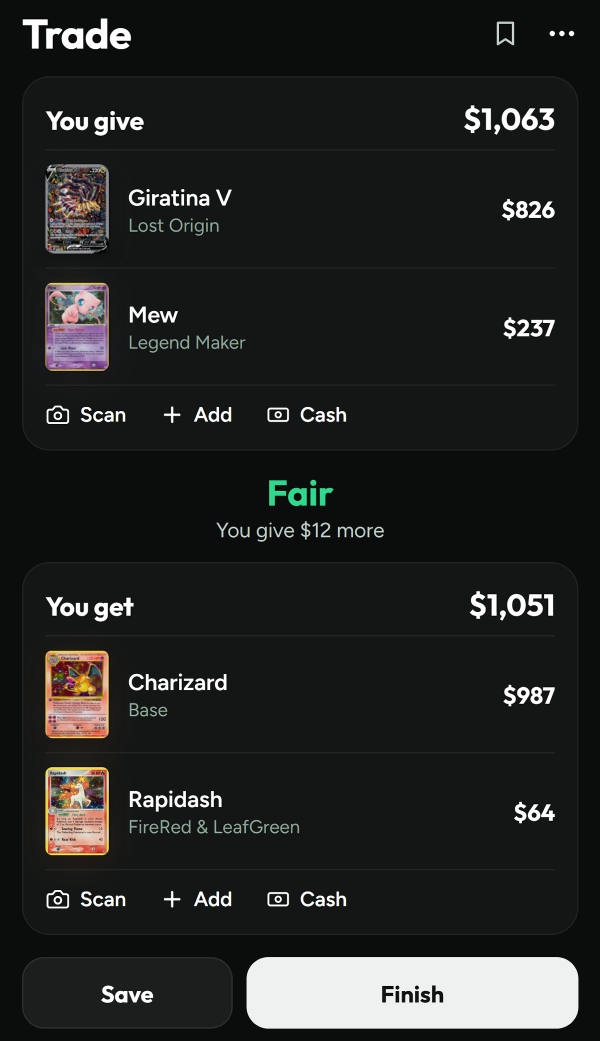
The Bartr trade screen does this sum. You give on top, You get underneath, a total on each, and a verdict between them. Add cash on either side and the verdict updates. In a browser, the free trade calculator does the same without the app.
Trading with a vendor
A vendor values your cards at a share of market, because they have to resell them and pay for the table. That is not unfair, but it is not an even swap either. Ask what rate they use, and compare it with their cash offer. How vendor trade-in rates work explains the numbers.
Find people who want your cards
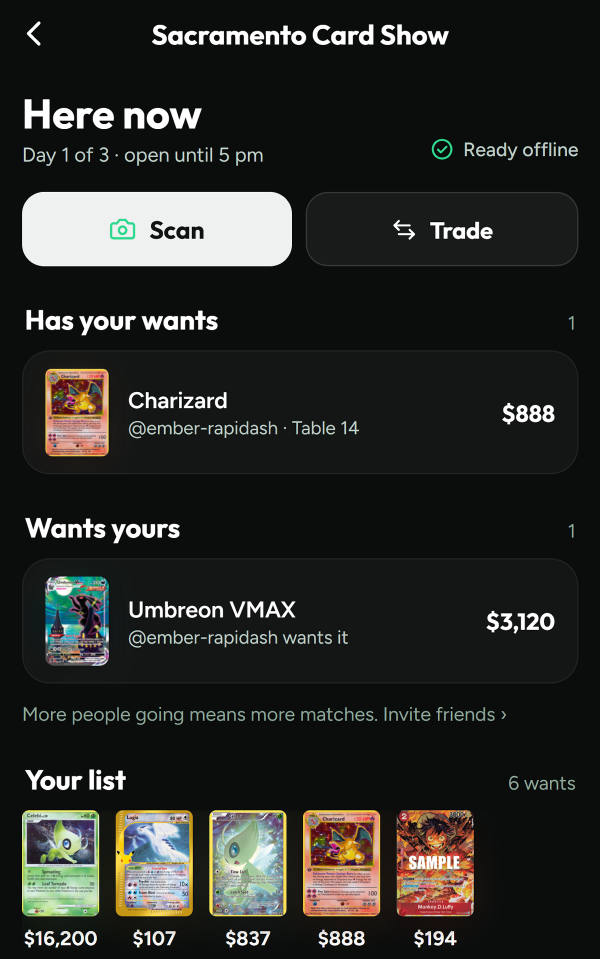
Trades are easier when the other person already wants what you have. In Bartr, when you are going to a show, Wants yours lists people going who are hunting a card you brought, next to Has your wants for the other direction.
Step by step
1. Price both sides from one source
Use the same place, and the same kind of price, for every card on both sides. Recent sold prices are the fairest common ground.
2. Match the exact card
Same set, same number, same printing, same grade or condition. A different printing is a different price.
3. Agree on condition out loud
Look at each card out of its sleeve and agree on the condition before anyone adds anything up.
4. Add up both sides and compare
Total each side, count any cash at face value, and look at the gap next to the size of the trade.
5. Balance it, then shake on it
Close a gap with cash or another card, or walk away politely. Only swap once you both agree, and note what you traded.
Saying no is fine
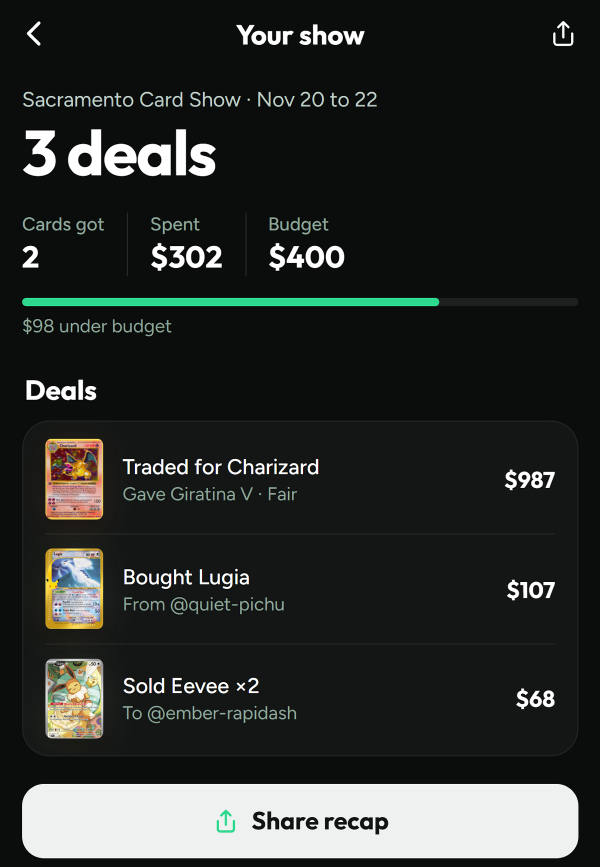
You never owe anyone a trade. If the numbers do not work, say thanks and move on. After the show, Bartr's recap lists each trade you finished with its verdict, which is a good way to see how your day went.
Quick answers
How do you know if a Pokémon card trade is fair?
Price every card on both sides the same way, from recent sales of the exact printing and condition, then compare the two totals. A small gap on a big trade is normal; a big gap is worth balancing.
Should a vendor give full value in a trade?
Usually not. A vendor has to resell what you hand over, so they value your cards at a share of market. Collector to collector trades are more often even.
What if we disagree on a card’s condition?
Look at it together under good light and use the standard condition words. If you still disagree, price it at the lower condition or leave that card out.
Is it OK to add cash to a trade?
Yes. Cash is the simplest way to close a gap, and it counts at face value on whichever side it is on.
Look up a card on the Pokémon card price pages or the One Piece card price pages, and read how Bartr prices cards. Bartr is an information tool, not financial advice.
Bartr prices both sides of a trade from the same daily market prices, shows the gap, and says when it is fair, before anyone hands over a card.
Get the app, or try the trade calculator in your browser first. Neither needs an account.