
Short version: Price every card from what that exact card, in that condition, has sold for lately. Ask a little above the price you would happily take, and know your floor. Put a readable label on everything, and update the fast moving cards the day before the show.
Buyers at a show check prices on their phones. Your labels get compared to the market in seconds, so a table priced from real sales sells, and a table priced from hope sits.
Start from sold prices
Use what copies actually sold for, not what they are listed at. Listings run high because the overpriced ones never sell and stay up. Sold price vs asking price explains the gap. Match the printing and the condition every time: a reverse holo and a holo of the same card are two prices, and so are Near Mint and Lightly Played. The Pokémon card price pages show a dated market price for each printing.
Leave room to haggle, and know your floor
Most buyers will haggle, so many vendors price a little above where they would happily sell. Decide your lowest price on the bigger cards before the doors open. A floor decided at home is a lot easier to hold than one invented while someone waits.
Raw and graded cards are separate markets. Price a slab from sales of the same grade from the same company, never from the raw card. Raw vs graded cards covers why.
Label everything
A card without a price is a question many buyers will not ask. Label every card you can, in writing big enough to read through a case. If you mark a few top cards Ask, keep it to a few.
Lay out the table by price
- Your best cards in the case, facing the walkway.
- Mid priced singles in binders, sorted by price or by set.
- Cheap cards in a box with one fixed price on a sign.
The show kit has free printable signs for a table.
Buying and trading at your table
You will be offered cards too. Vendors buy at a share of market because they have to resell, and many give more in trade than in cash. How vendor trade-in rates work covers how to set and explain yours. Use the same price source for what comes in as for what goes out.
Step by step
1. Start from recent sold prices
Look up what each card in that condition actually sold for lately, not what it is listed at. That is your market number.
2. Set an asking price and a floor
Price a little above where you would happily sell, and know the lowest you will take, so a haggle never catches you guessing.
3. Label every card
Put a readable price on everything. Unpriced cards slow your table down and lose sales to people too shy to ask.
4. Sort the table by price
Big cards in the case, mid cards in binders by price, and cheap cards in a clearly marked box or bin.
5. Recheck right before the show
Update the cards that move fast, new sets and hot cards first, the day before, so your labels match the market people check on their phones.
Keep it in the Vendor Desk
In Bartr, the Vendor Desk holds your for sale stock with its asking total and a quick sale total for when you want to move cards fast. A note at the top counts the cards that still need a price, so nothing goes to the show unlabeled.
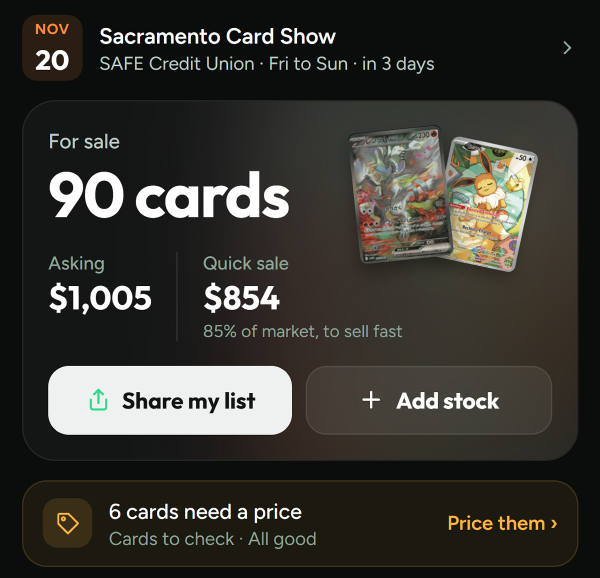
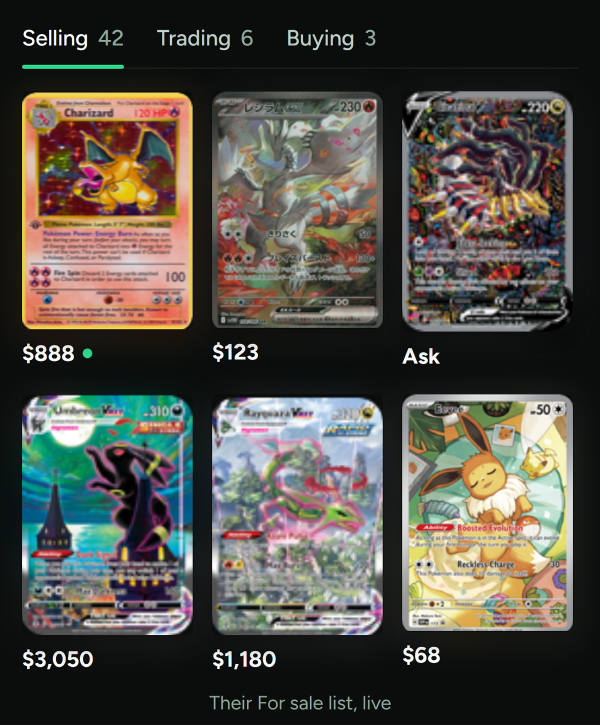
Share my list publishes your stock. When you go to a show in Bartr and use your For sale list for your spot, people going see it live, with your prices, and it stays in step each time you publish.
Quick answers
How do vendors price cards at card shows?
Most start from recent sold prices for the exact card and condition, then price a little above to leave room for haggling. Cheaper cards are often grouped into fixed price boxes.
Should I put a price on every card?
Yes, as a rule. Some vendors mark a few top cards Ask, but a table with prices on everything sells more, because buyers do not have to start a conversation to learn a number.
How much do vendors pay when they buy cards?
Usually a share of market value, because they have to resell the card and cover the table. The share changes with the card, and many vendors offer more in trade than in cash.
How do I handle haggling at my table?
Know your floor for each card before the doors open. Answer an offer with a counter, offer a better price for a bundle, and it is fine to say no.
Look up a card on the Pokémon card price pages or the One Piece card price pages, and read how Bartr prices cards. Bartr is an information tool, not financial advice.
Bartr has a Vendor Desk for sellers: your for sale stock with asking totals, the cards still missing a price, and a list you can share that people going to your show see live.
Get the app, or try the trade calculator in your browser first. Neither needs an account.