
Short version: A first edition card has a small round 1st Edition stamp and comes from the first print run of an early set. A shadowless card is an early English Base Set card with no shadow beside its picture frame. Each is a separate printing with its own price, so work out which one you have before you look anything up.
The 1st Edition stamp
A small black circle with a large 1 in it and the word EDITION. On a Pokémon card it sits on the left side, just below the bottom corner of the picture. On Trainer cards it's in the lower left of the card.
English sets carried 1st Edition prints only in the early years of the game, from Base Set through the Neo sets. The larger print run that followed each one is called unlimited and has no stamp. Later English sets were not printed with a 1st Edition run at all.
Some older Japanese sets carry their own 1st Edition mark, which looks different. Treat those as their own cards. Japanese vs English Pokémon cards explains why.
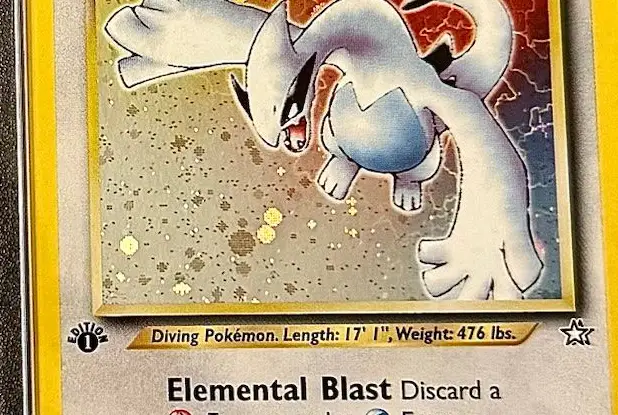
What shadowless means
Look at the gold frame around the picture on an English Base Set Pokémon card. Most copies have a dark shadow along the right side and bottom of the frame, which makes the picture look raised. The earliest prints don't. The frame looks flat. Those are shadowless cards, and they exist only in Base Set, the first English set.
There are other tells. The HP number at the top right and the attack text are in a thinner font than on the later print. Shadowless cards often look a little paler overall. And at the very bottom, the copyright line lists 99 among its years, which the later unlimited print does not.
The quickest way to be sure is to put the card next to a regular Base Set copy. The frame gives it away side by side.
The three early Base Set prints
- 1st Edition. The stamp, and no shadow.
- Shadowless. No stamp, and no shadow.
- Unlimited. No stamp, with the shadow. This is the common one.
So a Base Set 1st Edition card is shadowless too, but a shadowless card isn't always 1st Edition. The well known exception is the Machamp from the starter deck. It carries a 1st Edition stamp on every copy, and it exists with the shadow as well.
Base Set 2, a later reprint set, has its own set symbol and no 1st Edition print.
What it does to the price
Same artwork, different printings, different prices. How far apart they sit changes from card to card and over time, so there's no multiplier to carry around. Look up the exact printing.
On the Pokémon card price pages, find the set and the card and check which printing a price is for. How much is my Pokémon card worth? covers the full check, and sold price vs asking price explains why listings for old cards run high.
Watch for added stamps
The stamp changes the price, so some people add a fake one to a common card. On Base Set the first check costs nothing: a 1st Edition stamp together with a shadow on the frame doesn't add up, the Machamp aside.
Then look hard at the stamp itself. Compare its size, position and sharpness with photos of a known real one. A stamp that's thick, blurry, crooked or shiny in a different way from the rest of the print is a warning sign. How to tell if a Pokémon card is fake lists the checks that don't harm the card.
On a graded copy, the label names the printing. Read it against the card inside and look the cert number up. How to spot a fake PSA slab covers that.
Condition still counts
These cards have had a long time to pick up wear, and condition changes their price a great deal. Use the card condition guide for a raw copy, and raw vs graded cards if a slab is on the table.
Quick answers
How do I know if my Pokémon card is first edition?
Look for a small round stamp with a 1 in it and the word EDITION. On a Pokémon card it sits on the left, just below the picture. No stamp means it isn't a 1st Edition print.
What is a shadowless Pokémon card?
An early English Base Set card with no shadow along the right side of the picture frame. Later Base Set prints added the shadow, which makes the frame look raised.
Are all first edition Pokémon cards shadowless?
Only Base Set has shadowless cards. Base Set 1st Edition cards are shadowless, with one well known exception, the starter deck Machamp. Later sets have 1st Edition prints but no shadowless ones.
Popular sets: Prismatic Evolutions, 151, Destined Rivals, Evolving Skies, Base Set. Look up a card on the Pokémon card price pages, the One Piece card price pages or the Riftbound card price pages, and read how Bartr prices cards. Bartr is an information tool, not financial advice. See the Terms of Use.
Bartr prices a card by its exact printing. Scan it, confirm the version the app picked, and you get a dated market price for that one, or no price when there is nothing to go on.
Get the app, or try the trade calculator in your browser first. Neither needs an account.