
Short version: The top half of a Pokémon card is for playing the game, and the small print along the bottom is for identifying the card. To look one up you need the set symbol or set code and the card number, both at the bottom. Finish and condition aren't printed anywhere, so you check those by eye.
The rarity mark gets a page of its own, Pokémon card rarity symbols.
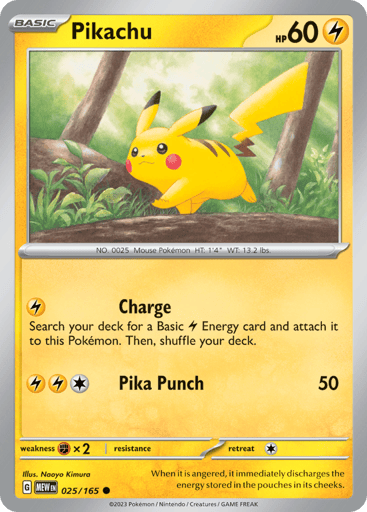
Top: name, HP and type
The name runs across the top, with HP and the type symbol at the top right. Next to the name, or just above it, the card says whether it's a Basic Pokémon or an evolved one, such as Stage 1 or Stage 2. Anything after the name, like ex, V or GX, is part of the name. Leave it off a search and you'll land on the wrong card.
Trainer and Energy cards say what they are at the top and carry rules text where the attacks would go.
Middle: art and attacks
Abilities and attacks sit under the picture. Each attack has its Energy cost on the left, then its name, then its damage on the right. Weakness, resistance and retreat cost run underneath.
None of this changes which card it is for pricing. It does help you check one, because every real copy of a printing has the same attacks, numbers and text.
Bottom: the part a price hangs on
- The set symbol or set code. Older cards have a small picture symbol for their set. Newer English cards print a short code of letters in its place. The very first English set has no symbol at all.
- The card number. Usually the card's place in the set over the set total. Promos use their own numbering, often with letters in it.
- The rarity symbol: a circle, a diamond or one or more stars. Pokémon card rarity symbols explains each one.
- The regulation mark. On newer cards, a single letter in a small box.
- The illustrator's name, near the picture or along the bottom, and the copyright line in the fine print at the very bottom.
The number does the heavy lifting
One number over another gives the card's place and the size of the main set. When the first number is higher than the second, you have a secret rare, printed beyond the main list.
Names repeat. One set can hold several cards of the same Pokémon with different art, and the number is the only thing that separates them. Search by set and number together.
Two marks people misread
The regulation mark is for organized play. The Standard format allows cards with certain letters, and the allowed letters change over time, so if you play in events, check the current list on the game's official organized play pages. For collecting, the letter is a quick hint at the era and that's all. It doesn't affect rarity, and older cards have no regulation mark.
The year in the copyright line is the copyright year of the design. It isn't proof of when your copy was printed, and reprints can carry different years from the cards they copy. Identify a card by its set and number, not by the year.
What isn't printed on the card
Three things change the price and none of them is written down.
- The finish. Holo, reverse holo and non-holo copies can share one card number. Tilt the card under a light to see which you have.
- The condition. See the card condition guide.
- Whether it's real. See how to tell if a Pokémon card is fake.
With the set, the number and the finish in hand, you can look the card up. The Pokémon card price pages are sorted by set, and each set page lists its cards in number order. How much is my Pokémon card worth? covers the rest of the check, and the printing checklist is the short version to keep at a table.
Quick answers
What does the number at the bottom of a Pokémon card mean?
It's the card number: in most sets, the card's place in the set over the set total. A number higher than the total marks a secret rare.
What is the letter in the small box at the bottom of the card?
The regulation mark. Organized play uses it to say which cards are allowed in the Standard format. It has nothing to do with rarity or value.
How do I find out which set my Pokémon card is from?
Find the set symbol or the short set code at the bottom of the card, next to the card number, and match it on a set list. The very first English set has no set symbol at all.
Popular sets: Prismatic Evolutions, 151, Destined Rivals, Evolving Skies, Base Set. Look up a card on the Pokémon card price pages, the One Piece card price pages or the Riftbound card price pages, and read how Bartr prices cards. Bartr is an information tool, not financial advice. See the Terms of Use.
Bartr reads these marks from a photo. Scan a card and the app matches the set and the number, then shows the printing it picked so you can confirm it.
Get the app, or try the trade calculator in your browser first. Neither needs an account.